Opening Doors in Science

How Min Kyu Lee (Veteran - PhD Chemistry) is Helping Military Connected Students Find Their Place in Research
By Lilly Wellons
Date June 8, 2026
Not many people can say they have spent the better part of a decade at the same university. Fewer still can say that time included an Army enlistment in between. Min Kyu Lee can say both.
Min is a triple Bruin, undergraduate, master's, and now 4th year Ph.D. candidate in the Department of Chemistry and Biochemistry, all at UCLA. After serving four years on active duty in the United States Army as a medic, he returned to campus and never left. Today, he conducts research on polymers and sustainable materials in the lab of Professor Richard B. Kaner, exploring eco-friendly approaches to developing new technologies with applications across medicine and industry.
But alongside his research, Min has taken on a different kind of work, one rooted less in the lab and more in what happens before a student ever gets there.
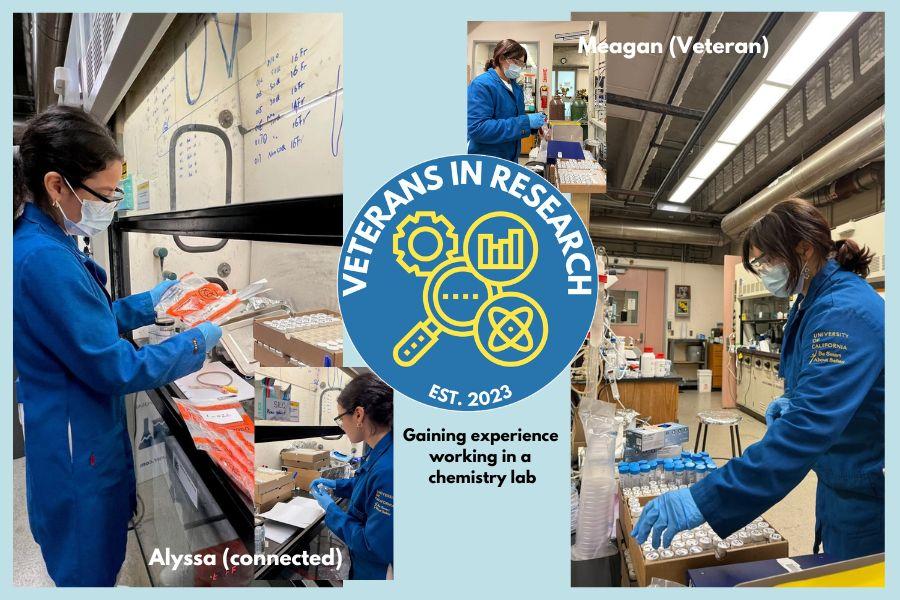
This fall (2026), Mr. Lee will be in a leadership position of the Veterans in Research program, a UCLA Veteran Resource Center career path service, that connects military-connected students with research opportunities across campus. Breaking into undergraduate research at UCLA is notoriously competitive, and for Veterans navigating an already demanding transition back into academic life, that barrier can feel especially steep. Min knows this firsthand, as an undergraduate, he tried to find a research position and came up short.
"I always think to myself, I wish I had that same opportunity," he said. "And I'm pretty sure a lot of our Veteran researchers share the same thought."
Through the VRC, Min has been able to advertise research openings directly to the military-connected community and recruit students into his own lab. So far, he has mentored five military-connected undergraduate researchers, Veterans and dependents, and welcomed two more this past quarter. He describes the experience as one of the most rewarding parts of his time at UCLA, and says Veteran students bring qualities to a research setting that are immediately visible.
"Veterans come in with a sense of purpose," he said. "Not because their parents are telling them to, not because they need to do four years of college. They're coming in because they want to be there. They choose to be there. And that gives them a real edge."
That clarity, he says, translates directly into the demands of research work, in the way students take ownership of problems, function within a team, and show up consistently.
"When it comes to teamwork, transparency, getting things done, taking responsibility — they have it all," he said. "The cycle is just going to keep going."
The VRC has been central to Min's own journey at UCLA as well. During his undergraduate years, resources made available through the VRC covered the cost of his degree entirely, without him ever needing to touch his Post-9/11 GI Bill.
"I can't thank VRC enough for giving me that opportunity," he said. "They've been continuously helping me during my Ph.D. journey, and they continue to promise to do so. So here I am."
For Min, leading Veterans in Research is less a leadership role than an extension of something the military already taught him.
"We're a community," he said. "From the team to the company to the battalion to the brigade — we all come from one community, and that's how the work gets done. Veterans truly understand that."
As for what comes next, Min has his sights set on entrepreneurship and hopes one day to launch a startup rooted in the materials science he has spent years developing. But for now, his focus remains on the students he is helping find their footing in science.
"I just want them to have the same opportunity I was given — to find their direction, to build their confidence, and to know that they belong here."