Career Development
These program and suggestion support undergraduate and graduate students.
Career Pathway Programs
Click on images for more information
 Veterans in Healthcare
Community of healthcare and military-connected students at UCLA working together to achieve our goals of becoming medical professionals through volunteering, research, mentorship, MCAT/DAT study strategies, guidance in obtaining letters of recommendation, application counseling, course list advising, and advocacy work for current medical students.
 Veterans in Humanities
We are a veteran-led group aiming to educate, connect, and highlight our peers' growing research interests and opportunities in the humanities disciplines.
 Veterans in Law
The purpose of the program is to assist military-connected students with access to affordable pre-law advisement & support; an emphasis on first-generation/low-income/enlisted veterans; and facilitate a more comprehensive veteran-to-law school pipeline via establishing a community and mentorships with student-veterans already attending law school.
 Veterans in Research
We are a veteran and military-connected student led group with a goal to educate and connect research opportunities with our peers.
 UCLA Career Center
Strathmore Building North Entrance
2nd & 3rd Floors
501 Westwood Plaza, Los Angeles, CA 90095
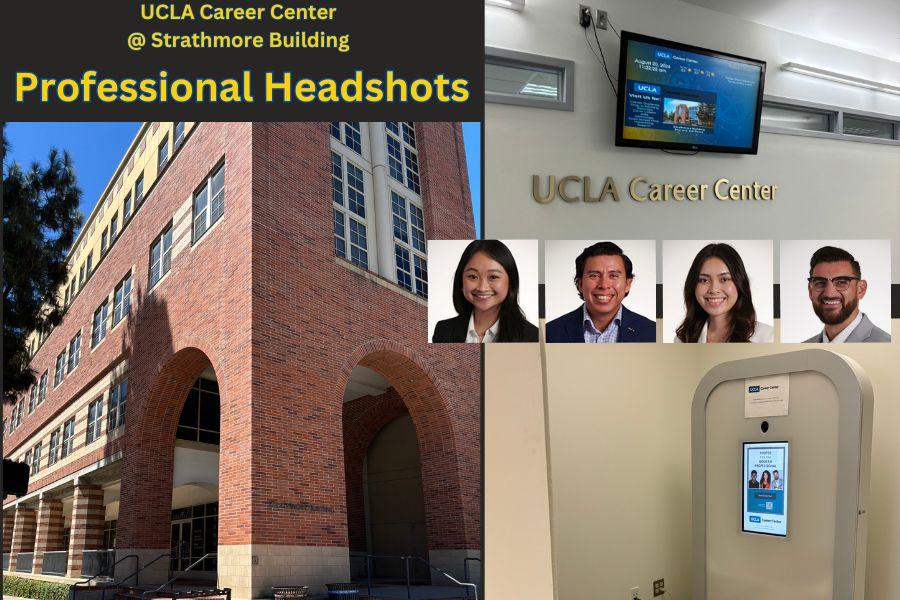 Professional Headshots
Head to the Career Center to get 3 free headshot for your LinkedIn profile page. Click on the banner to find out how to get to the Strathmore Building from the VRC.
Introducing Yourself:
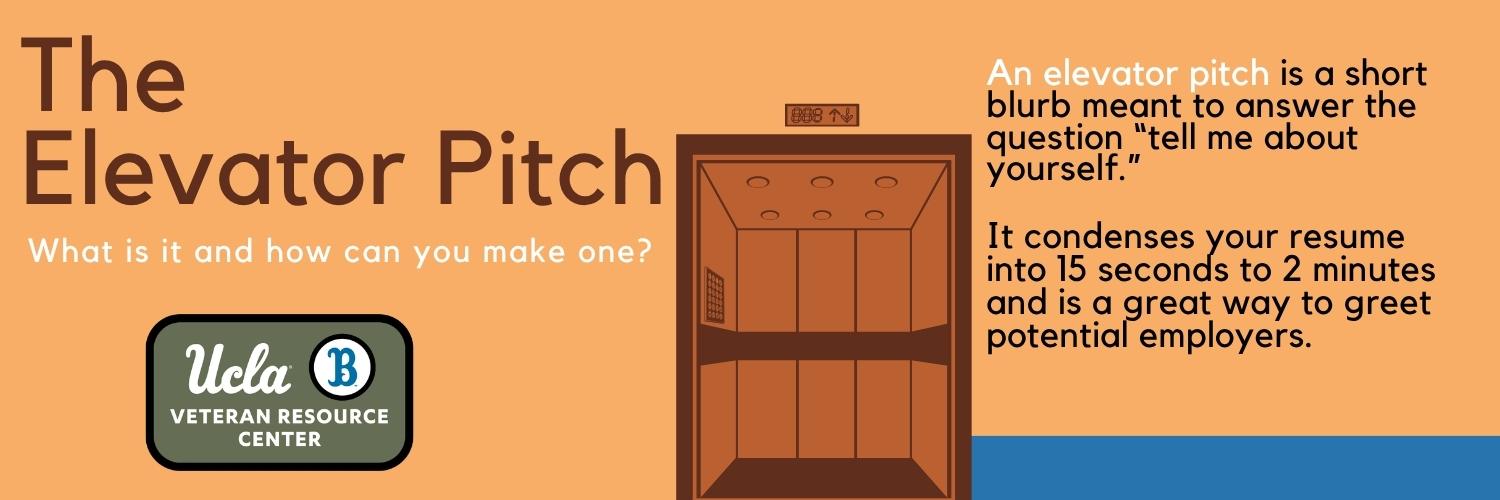
4 Key Elements of a Successful Introductive Pitch:
- INTRODUCTION: Answers the questions who am I? What field or industry am I in? What is my role?
- WHAT & WHY: What are you looking for and why are you exploring new opportunities?
- DIFFERENCE: Describe what makes you stand out and what employers can gain from having you on their team.
- ASK: Ask the listener for their business card, to grab coffee, or even give them your resume for future prospects.
Smoothness in an elevator pitch isn't about memorizing a script word-for-word. Your delivery feels conversational, adaptable, and effortless. Some helpful tips:
Structure in "Modules" Rather Than Sentences
- Break your pitch into four modular pieces: The Hook, The Value, The Proof, and The Call to Action. Master the core message of each module independently. This prevents you from sounding robotic and allows you to adjust on the fly if the listener interrupts or engages early.
Practice Out Loud (and Record Yourself)
- Reading a pitch in your head creates a false sense of fluency. Record a voice memo or video of yourself speaking naturally. Listen back to spot awkward phrase transitions, verbal fillers ("um," "like," "you know"), and speed spikes caused by nervousness.
Trim the Jargon and Simplify Wording
- Industry buzzwords and overly complex sentences trip up your tongue and force the listener's brain to work harder. Replace rigid, resume-style phrasing with simple, active spoken English. If a sentence takes more than one natural breath to say, shorten it.
Anchor on Your First and Last Sentences
- Nail your opening line so you start with zero hesitation, and lock down your closing question/call to action so you end cleanly without trailing off into awkward silence. When your start and finish are rock-solid, the middle flows much more naturally.
Test It in Low-Stakes Conversations
- Try out individual components of your pitch during casual networking, social chats, or low-stakes introductions. Notice where people lean in or nod, and where their eyes glaze over. Real-world feedback shows you where your delivery loses momentum.