From Service to Storytelling

How Matt Haro Blends Military Discipline with AI Innovation
By Lilly Wellons
Jan. 30, 2026
For many Veterans, life after service can be daunting.
The structure that once dictated each hour disappears, replaced by choices that can feel both liberating and disorienting. Returning to school, especially to pursue a passion, can seem less like a continuation and more like a leap.
But for Veterans like Matt Haro, it became an unexpected path back towards himself, rediscovering his own passion, purpose, and potential.
Haro, now a third-year MFA Animation student at UCLA, embodies that exact mentality. On Friday, January 30th, he premiered his animated short Van Helsing’s Journal for the School of Theater, Film and Television’s AI + Storytelling Summit at the James Bridges Theater. The project, funded through the Amazon GenAI fellowship initiative, was showcased alongside six other Student Artist Lightning Talks, each exploring how emerging voices in film and animation are using generative AI to push the boundaries of creativity, efficiency, and accessibility.
However, at the center of all of this excitement, is Haro. A Veteran who has not only pursued grad school, committed to an extremely competitive program, and broke into the film industry but is now a part of the innovators working to shape the future of storytelling.
Haro’s film emerged from the fellowship, where students were asked to propose ways generative AI could be integrated into their creative process. Haro, one of two animation students selected from UCLA’s MFA programs, used AI-generated background art to build cinematic environments around his hand-drawn characters. His project fused hand-drawn character animation with these models to create a proof-of-concept pilot in just one year, a timeline that, in traditional animation, can stretch far longer.
“With the GenAI software, I literally got it done in a one year time span,” Haro said. “Aside from the music, everything was by myself. I did all the animation, I did the voice acting, I did the editing.”
The discipline required to sustain that kind of solitary effort was not new to him. Haro credits the military with reshaping his relationship to work and to himself. He admitted that before service these personal skills were a weak point for him.
“In undergrad I was a bit of a slacker,” he laughed. “But with the discipline that was incurred through the military, I now know—when you get a task, you want to just get it done so you don’t have to worry about it later.”
He enlisted in 2019 after completing his undergraduate degree. The shift was immediate. As an officer, he carried responsibility, but he resisted the idea that rank conferred distance.
“You shouldn’t really put yourself on a pedestal,” he said. “We all sweat the same. We all bleed the same. We all cry the same. And we all feel pain. We’re all the same.”
What the military gave him, unexpectedly, was not only discipline but discovery. During the COVID-19 lockdowns, confined largely to his barracks, Haro began recording character voices on his phone, at first just as a way to pass the time. He improvised accents, invented personalities, and gradually converted his room into a makeshift recording booth.
“It was keeping me sane,” he said. “And I realized—yeah, I love doing this. I’d love to do this for a living when I get out.”
That hobby became the foundation of his creative practice. Today, Haro performs many of the voices in his own films. Moving between animation and voice acting has given him a true understanding of how to make a character feel real.
His return to academic life came through the Army’s Green to Gold Program, which allowed him to complete a master’s degree in Cinema and Media Studies while finishing his ROTC training. The demands of both worlds overlapped, often uneasily.
“It was definitely a lot to juggle,” he said. “But no matter how hard it sucks at the moment, as long as you push through and don’t give up, you’re gonna find the light at the end of the tunnel.”
But for him the experience was nothing but rewarding. It was during this graduate program, in an introductory animation course, that everything clicked for him.
“As soon as I did the bouncing ball exercise – a classic basic animation exercise – I was like – yeah. This is my thing.”
When asked what he would say to Veterans unsure about their path after service, Haro didn’t hesitate.
“If you have a knack for an activity or a hobby—look into it. You never know if it’s your passion waiting to finally come out,” he said.
Haro emphasized that passion often hides in plain sight:
“Focus on what you do to pass the time. Expand upon it. That’s probably your body telling you—this is your passion. Open it up and achieve your full potential.”
Haro is currently serving in the reserves and training at Fort Jackson. He plans to submit Van Helsing’s Journal to the UCLA Animation Festival in June, hoping to see it projected on a theater screen. His career remains in its earliest stages, but its direction feels deliberate.
Haro’s story resists easy framing. It is not simply about reinvention, or technology, or even ambition. It is about attention, the act of noticing what sustains you, and having the patience to follow it. For Haro, that path began in a barracks room, with a phone and a voice, and has led, step by step, to a theater screen.
Video Links
VRC Animated Overview
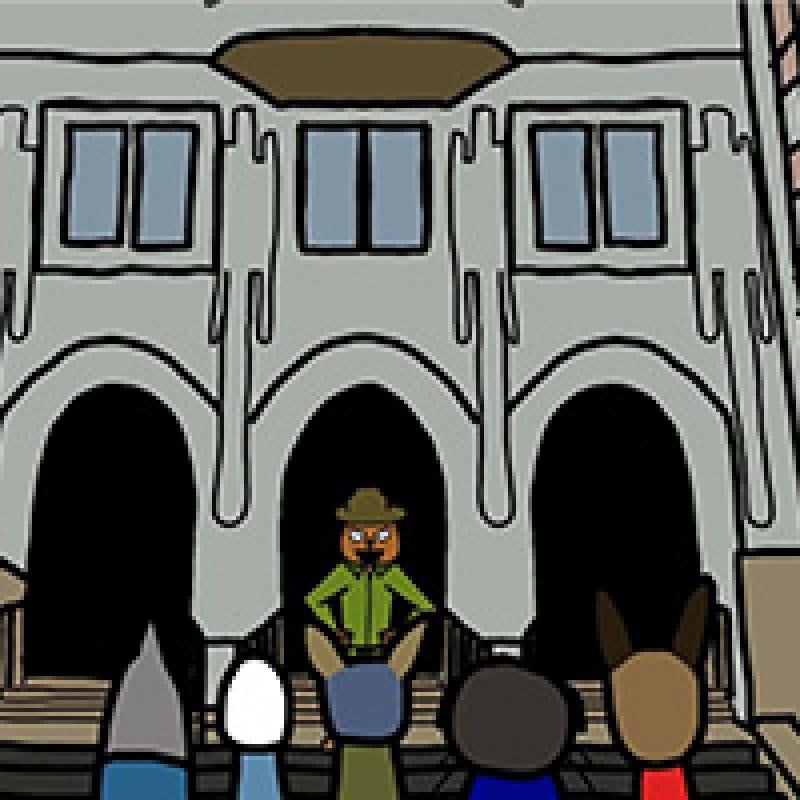
A VRC animation created by army Veteran and grad student Luna Lee and Matt Haro provided the voiceover.